# Making Life Support Certification Convenient for Bethesda Professionals
Let’s face it: keeping your clinical credentials valid is rarely a walk in the park. If you work in healthcare around Montgomery County—whether you're scrubbing in at local medical centers, managing dental practices, or supporting community health clinics—your calendar is already maxed out. Juggling double shifts, unpredictable patient cases, and personal downtime means that sacrificing an entire weekend to sit in a rigid classroom environment feels less like professional development and more like an endurance test.
Fortunately, the landscape of medical education has evolved. If you need trusted **[CPR Classes in Bethesda](https://cprcart.com/locations/maryland/bethesda/)** that honor your demanding routine, a modern hybrid framework offers the ultimate shortcut to compliance without the usual administrative headaches.
## Why Legacy Training Models No longer Fit Modern Schedules
For years, acquiring a standard **[CPR Certification](https://cprcart.com/)** meant writing off a full Saturday. Think fighting traffic down Rockville Pike, cramming into a stuffy room, watching outdated video cassettes, and waiting endlessly for your turn on heavily used mannequins. For experienced nurses, paramedics, and physicians who manage emergency scenarios daily, sitting through hours of basic procedural review is tedious.
Worse yet, legacy classes lack agility. If a critical shift extension or personal emergency forces you to miss a designated class, you are suddenly stranded weeks behind schedule. Medical professionals needed a frictionless way to secure vital qualifications—whether that means earning a standard BLS Card for general bedside care or advanced certifications for high-stress units.
## The Smarter Approach: The AHA HeartCode® Framework
To eliminate the friction of traditional courses, the American Heart Association (AHA) pioneered flexible, blended learning pathways. Today, securing your BLS Card, ACLS Card, or PALS Card is built around a convenient two-phase model:
Phase 1 – Self-Paced Digital eLearning: You tackle all cognitive coursework online whenever and wherever it fits your life. Whether you log in late at night after your shift or early in the morning before your clinic opens, the adaptive platform lets you breeze past concepts you’ve mastered while spending extra focus where you want a refresher.
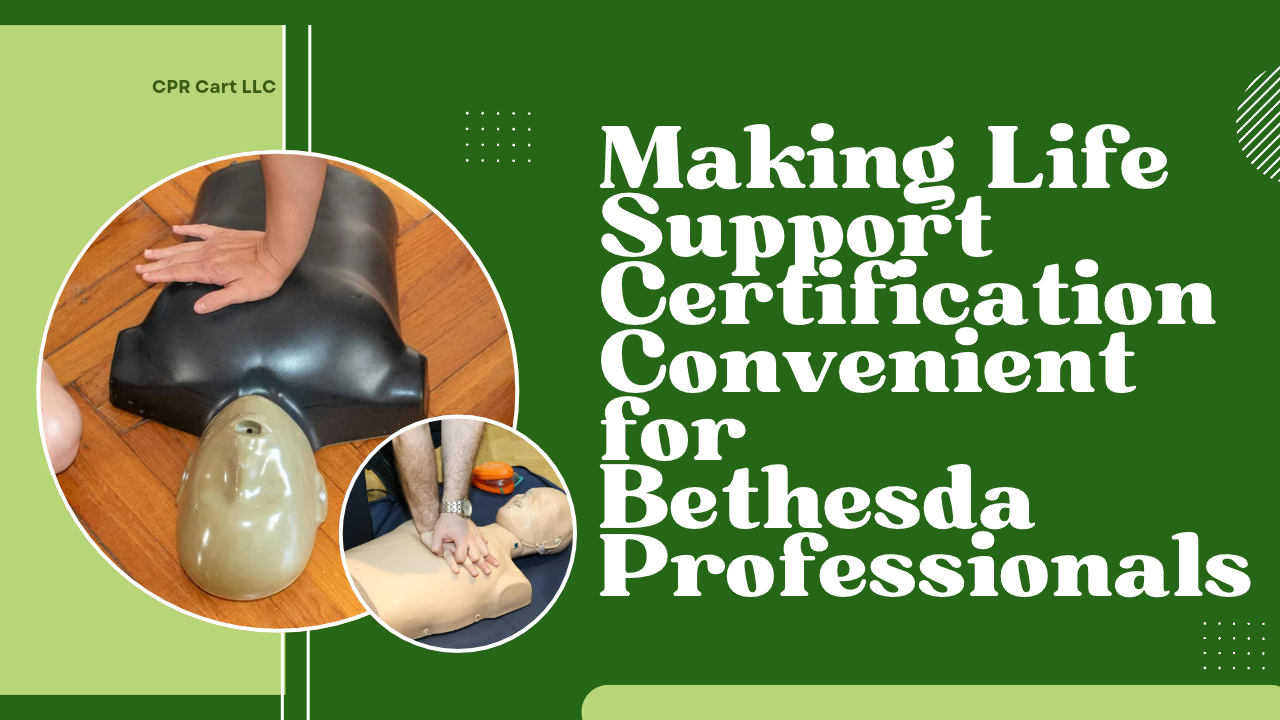
Phase 2 – The Rapid 30-Minute Practical Lab: Once the online modules are checked off, you drop by a local Bethesda verification lab for a fast-tracked physical evaluation. Lasting roughly 30 minutes, this touchpoint hones in entirely on core physical mechanics—chest compressions, bag-valve-mask deployment, and AED manipulation—using smart feedback tools.
The moment your brief practical check concludes, your official, AHA-compliant digital eCard is generated, often landing in your inbox the exact same day!
**Claiming Your Foundational BLS Card**
Basic Life Support stands as the universal baseline for virtually all clinical and patient-facing personnel. Whether you are an RN, dental hygienist, physical therapist, or pharmacy technician, possessing an active **[BLS Card](https://cprcart.com/classes/bls/)** is non-negotiable for employment.
This curriculum centers on high-performance adult, child, and infant resuscitation, airway obstruction relief, and seamless AED operation. By decoupling the lectures from the physical checkoff, renewing your BLS status in Bethesda has never been faster or more accommodating.
**Elevating Critical Care with an ACLS Card**
High-acuity medical environments demand specialized expertise. An **[ACLS Card](https://cprcart.com/classes/acls/)** (Advanced Cardiovascular Life Support) is an essential prerequisite for clinicians operating in emergency rooms, intensive care units, and critical transport vehicles.
This advanced training hones your capability to navigate complex cardiac arrhythmias, direct code team dynamics, manage emergency airway devices, and execute rapid pharmacological protocols during cardiac crises. Securing your ACLS credential through a targeted, 30-minute hands-on lab keeps you at the pinnacle of critical care readiness without disrupting your roster.
**Mastering Pediatric Resuscitation with a PALS Card**
Resuscitating infants and children requires precise weight-based calculations, specialized equipment handling, and distinct pediatric algorithms. Obtaining your **[PALS Card](https://cprcart.com/classes/pals/)** (Pediatric Advanced Life Support) is vital for physicians, pediatric nurses, and emergency medical technicians who treat young patients.
A PALS credential proves you are fully equipped to manage severe pediatric respiratory distress, shock states, and cardiac arrest. By pairing comprehensive digital case studies with a streamlined, stress-reduced local skill session in Bethesda, pediatric specialists can maintain their life-saving qualifications smoothly.
**What to Expect at Your Bethesda Practical Station**
When you arrive at your scheduled practical evaluation in Bethesda, you won't find a lecturer standing over your shoulder with a clipboard. Because the cognitive theory was completed online beforehand, the in-person lab is entirely dedicated to tactile performance.
Training hubs utilize advanced feedback manikins equipped with real-time digital sensors that track compression depth, rate, and chest recoil instantly. This objective system provides instant adjustments, ensuring your technique aligns perfectly with current AHA guidelines. The atmosphere is quiet, efficient, and pressure-free: you step up to the equipment, verify your physical competency, and head right back to your day.
**Secure Your Credentials Today**
Keeping your documentation up to date shouldn't feel like a second job. By harnessing online cognitive learning paired with an ultra-efficient 30-minute hands-on evaluation, you can conquer your compliance requirements on your own terms. Reclaim your calendar, protect your valuable downtime, and stay focused on what truly matters—delivering exceptional patient care.